
We’ve Got Your Back Part 2
Happy Thursday everyone! I’ve got a fun article to share and build on some themes from last week. Today we will learn about disc extrusions and sequestrations. Last week we learned that our discs are made of a tough outer layer, the annulus, and an inner layer called the nucleus. One quick note, many times the nucleus has been described as jelly. New research tells us it’s much tougher and durable than we previous thought. Think more like a big piece of chewed gum.
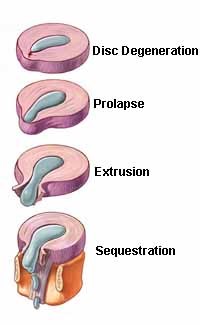
Spinal disc. Pink is the tough annulus and gray is the nucleus. Another scary picture that won’t be as scary by the end of this post, I promise!
An extrusion is when the nucleus breaks through the annulus. A sequestration is when the nucleus has broken through and is leaking. Remember our key concept from Part 1: The worse the disc, the more likely it is to heal on its own! Let’s dive into a neat article that reinforces this!
A 45-year-old male was admitted to the hospital with 3-months of low back and right leg pain. The “before” picture below shows an L3-L4 extrusion (nucleus has broken through the annulus wall). The patient chose to try physical therapy before deciding on surgery. The patient experienced full resolution of symptoms with no neurological signs. 9 months later we have an “after” MRI with full spontaneous resolution of the extrusion. In research terms we call this spontaneous Regression.
Impressive before and after. Although this individual completely recovered without pain, he still has an L4-L5 herniation. How can that be? Stay tuned next week for some powerful answers!

This individual’s doctors were so blown-away by the spontaneous regression, they did a deep dive into 22 case studies from fellow doctors to try and figure out how and why this can happen. The patients in these studies all had extrusions or sequestrations along with:
- 40% had sequestered discs with pain down the leg (radiculopathy)
- 36% had decreased reflexes
- 41% had weakness
- 45% had weird sensations of touch/feel[i]
Within an average of 5 months, all these 22 patients had full resolution of symptoms along with spontaneous regression. Although we’re not sure the exact mechanism, we know what works to help.
The worse the disc bulge/herniation/extrusion/sequestration, the more likely it is to heal when combined with conservative management. I’m sure each of these individuals had good days and bad days during their PT sessions, but have hope that your situation can improve! We’ve seen it countless times: Empathizing with your pain, education, reassurance, and gradual exposure to what you NEED and LOVE to do. This is the formula for success! There are no quick fixes, but rest assured we can create a success-plan that works for you!
[i] Yang, X., Zhang, Q., Hao, X., Guo, X., & Wang, L. (2016). Spontaneous regression of herniated lumbar discs: Report of one illustrative case and review of the literature. Clinical neurology and neurosurgery, 143, 86–89. https://doi.org/10.1016/j.clineuro.2016.02.020
Recent Comments